
Speed Summary | HBR on Social Media & New Rules of Branding
18
This month’s Harvard Business Review has a spotlight on social media and branding, with a stand out article by McKinsey, based on a global study of 20,000 consumers. In a nutshell, the article argues that many brands are spending their marketing budgets in all the wrong places, based on an outmoded “funnel” marketing model – and proposes an evidence-based alternative.
The article by David C Edelman – McKinsey Global Digital Marketing Strategy, and entitled “Branding in the Digital Age: You’re Spending Your Money in All the Wrong Places“ can be accessed here (pay-wall), but below you’ll find the speed summary, with implications for social commerce – we think it’s useful. And if you don’t have time for that, here’s the summary of the summary
- CEPEA – Bin the funnel model of marketing, the new consumer decision journey is CEPEA – Consider, Evaluate, Purchase, Enjoy, Advocate.
- CEP the CEPEA – Trash media-centric marketing; marketers should build strategy around customer-centric Customer Experience Planning (CEP) that delivers the brand promise coherently and consistently along touch-points of the CEPEA decision journey
- Rather than simply add a social layer to e-commerce, or an e-commerce layer to social properties, smart social commerce should focus on the consumer decision journey, with the objective of helping people make smarter shopping decisions – where they most need that help.
- Every social commerce program should begin with understanding the consumer decision journey with a view to identifying touch points that are most influential in facilitating decisions.
Branding in the Digital Age: You’re Spending Your Money in All the Wrong Places.
David C Edelman – McKinsey Global Digital Marketing Strategy
- Consumers today connect with brands in a fundamentally new way, often through media channels that are beyond manufacturers’ and retailers’ control. This means traditional marketing strategies must be resigned to accord with how brand relationships have changed
- Consumers still want a clear brand proposition, what has changed is when – at what touch points – consumers are open to influence
- Once, a shopper would systematically winnow his brand choices to arrive at a final selection and complete his engagement by making a purchase. Now relying heavily on digital interactions, he evaluates a shifting array of options and remains engaged with the brand though social media after a purchase
- Marketing mis-spend is often the result of using a bad funnel metaphor, whereby consumers were thought to use a process of elimination to get from a wide consideration set down to a final choice. This bad metaphor leads to bad marketing – paid media push marketing used to drive consumers along the imaginary funnel, culminating in retail promotions to open wallets at point of purchase.
- However, this two-pronged marketing strategy does not reflect the consumer decision journey (CDJ); there is more to the CDJ than “consider” and “buy” phases.
- The new CDJ is CEPEA – CONSIDER-EVALUATE-PURCHASE-ENJOY-ADVOCATE, with a LOYALTY LOOPshortcut leading to re-purchase (and skipping future consideration and evaluation) if enjoyment experienced meets or beats expectations
- Rather than begin with a large consideration set, consumers today manage massive choice with smaller initial consideration sets, but that may grow, based on active evaluation
From an accompanying McKinsey Quarterly article: The Consumer Decision Journey
-
-
- After consideration phase, consumers will now actively evaluate options, seeking input from peers, reviewers, retailers, brands and competitors. Rather than shrink, the number of options under evaluation may grow during this phase
- Increasingly consumers will continue evaluation right up to the moment of purchase in store – thus point of purchase (placement, packaging, availability, pricing) is increasingly important
- Post purchase, interaction continues – 60% of facial skin cream consumers do online research on the product after purchase. If they enjoy the product, they’ll advocate it to others, thus becoming a touchpoint themselves – influencing further purchases, and enter into an ENJOY-ADVOCATE-REPURCHASE loyalty loop that buy passes initial phases of the CDJ
-
- Smart marketers will study the “consumer decision journey” for their products and use the insights they gain to revise strategy, media spend and organizational roles.
- First, marketers should stop media-centric budget allocation, and replace it with customer-centric approach, targeting stages in the CDJ
- 79-90% of marketing spend goes to advertising and promotions that hit consumers at the consider and buy phases, but consumers are often more open to influence at the evaluate and advocate stages
- The bad funnel metaphor leads to an outmoded and outdated marketing strategy that vastly over-weights the significance of paid media. Today owned media (websites (and customer service, sales, packaging)), shared media (social sites) and earned media (third party site content) are significant touch-points
- First, marketers should stop media-centric budget allocation, and replace it with customer-centric approach, targeting stages in the CDJ
-
- Second, marketers should begin by running a pilot based on the new rules of branding for a particular product in a particular market to demonstrate the potential of a more sophisticated approach to senior leadership
- 1) Chart the customer decision journey for your product – what they do, what they see and what they say, for the five CEPEA stages
- This will involve an upfront shopper researchproject (protocol analysis) to understand the CDJ, and identify key touch-points of influence
- (e.g. when are offline channels such as TV advertising and word of mouth most important (consideration phase), do consumers use the website during the evaluation phase (no – less than 1 in 10 do), do they use search engines (no, they go directly to Amazon)?
- This will involve an upfront shopper researchproject (protocol analysis) to understand the CDJ, and identify key touch-points of influence
- 1) Chart the customer decision journey for your product – what they do, what they see and what they say, for the five CEPEA stages
- Second, marketers should begin by running a pilot based on the new rules of branding for a particular product in a particular market to demonstrate the potential of a more sophisticated approach to senior leadership
From an accompanying McKinsey Quarterly article: The Consumer Decision Journey
-
-
- 2) Develop your marketing strategy around a coherent CUSTOMER EXPERIENCE PLANthat leverages the key touch points in the CDJ
- Match experience to expectations and keep it coherent
- e.g. Apple’s CEP involving systematically removing jargon across all touch points, making technology friendly across all touch points through online help videos, ads, and in-store Genius Bars
- e.g. Nike offers a coherent experience, bringing the just do it motto to life with online tools and events that help people to just do it.
- Match experience to expectations and keep it coherent
- 3) Allocate resources accordingly and embrace three new roles for marketing
- “Orchestrator” – Many touch-points are now owned media – customer service, packaging, website and sales – and marketers need to coordinate this media, either through internal collaboration or direction in order to offer a coherent Customer Experience Plan
- “Publisher” [Content Supply Chain Manager] – The rise of shared and owned media means that marketers now have to produce or commission vast amounts of content – all of which should work together to deliver a coherent experience (one McKinsey client estimates each product launch requires the production of 160 prices of content, involving 20 parties across 30 touch-points – this needs management
- “Analyst” [‘Marketplace Intelligence Leader] – The success of your CEP will depend on acting on insightful customer understanding, itself the result of data collection and analysis. This means bringing research and analytics under the umbrella of marketing, rather than stuck in IT and research silos
- 2) Develop your marketing strategy around a coherent CUSTOMER EXPERIENCE PLANthat leverages the key touch points in the CDJ
-
- Implications for social commerce
- Most digital marketing – including social commerce – is still based on old and defunct funnel/AIDA model (leading to a fetishization of traffic, transactions, conversion and paid media), whereas the way consumers navigate the digital media landscape has fundamentally changed. Social Commerce managers need to become “Orchestrators” and “Content Supply Chain Managers” at ease with earned, shared, and owned media as well as paid media… We need to rethink social commerce in terms of UX (user experience) and realise that the future of social commerce, and more broadly, digital marketing, is Customer Experience Planning…
- Rather than simply add a social layer to e-commerce, or an e-commerce layer to social properties, smart social commerce should focus on the consumer decision journey, with the objective of helping people make smarter shopping decisions – where they most need that help.
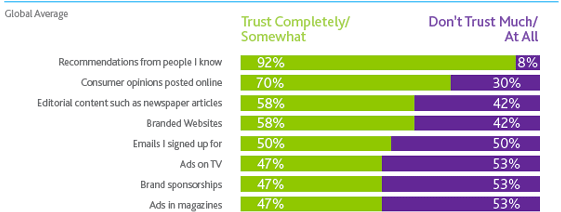
- Insofar that the essence of social commerce is the concept of word of mouth applied in the context of e-commerce, social commerce solutions have a naturally fit with the Advocacy phase of the consumer decision journey – where consumers themselves become brand influential brand touchpoints
From an accompanying McKinsey article on advocacy…
-
- Because the Advocacy phase of the Consumer Decision Journey is part of the “Loyalty Loop”, the implication is that from a consumer decision journey perspective, social commerce may be primarily a Loyalty Loop solution (suited for stimulating loyalty rather than acquisition)
- Social Commerce should be deployed as part of an integrated Customer Experience Plan, not as a standalone initiative. Critical consideration should be given to Experience (UX) delivered by social commerce. If your social commerce solution doesn’t offer a gold standard experience within the consumer journey, you’re unlikely to reap rewards.
From an accompanying McKinsey Quarterly article: The Consumer Decision Journey
From this…
…To this


Pingback: Tweets that mention marketing Speed Summary | HBR on Social Media & New Rules of Branding ... #digitalmarketing -- Topsy.com
Very compelling… I would also like to point out that a solid component of any marketing effort is strategic, printed publication advertisements. There is no doubt that online and social media marketing is bringing great success to many, but there is something to be said for holding a tangible ad. It provides and air of instant credibility and professionalism.
Focus on the internet marketing, but don’t forget to supplement with print media especially in your local markets.
Pingback: Speed Summary| HBR on Social Media & New Rules of Branding « Fredzimny's CCCCC's
Last 2 implications really hit home the social commerce value prop.:
* Rather than simply add a social layer to e-commerce, or an e-commerce layer to social properties, smart social commerce should focus on the consumer decision journey, with the objective of helping people make smarter shopping decisions – where they most need that help.
* Insofar that the essence of social commerce is the concept of word of mouth applied in the context of e-commerce, social commerce solutions have a naturally fit with the Advocacy phase of the consumer decision journey – where consumers themselves become brand influential brand touchpoints
Although transactions and sell-through are the “holy grail” for retail there are other value propositions for social commerce activity in FB and/or other social channels. It may be as worthwhile to study the qualitative aspects of connections versus quantitative aspects:
* What sells with what and to whom?
* Who are the social “purchase influencers”?
* Shopping habits across your web site and Facebook?
* Who is sharing your brand and where?
Selling a data-driven product to retailers who don’t see past the hokus pokus “social graph” nonsense of hanging a basic catalog off a FB storefront tab has a lot of potential.
Cheers,
David
Pingback: Havard Business Review on Social Media & New Rules of Branding « Chicacu's Blog
Pingback: The New Purchase Journey « Ed Lee's Blogging Me Blogging You | @edlee
Pingback: Las nuevas reglas del Branding y los medios sociales | Marketing y Consumo
Pingback: Harvard Business Review on Social Commerce | NY French Geek
What are the implications of this paradigm shift for targeting multicultural consumers?
Pingback: What Will Sell on Facebook? Insights from Word-of-Mouth Research | Social Commerce Today
Pingback: La Evolución del Social Media hacia el Social CRM | 300 PALABRAS DE MARKETING
Pingback: Social Media Strategy Class Reading List - by Ben Foster
Pingback: Top Ten Social Commerce Posts During 2011 | Social Commerce Today
Pingback: How to Build a Social Media Ambassador Program | PR at Sunrise
Pingback: 30% Growth For Online Retailer By Mapping Customer Decisions | CaseStudiesOnline.com
Pingback: social media influence | TribalCafe
Pingback: The 6 Weapons of Social Commerce - The Psychology of Influence | TribalCafe
Pingback: Social Media Demystified: McKinsey Style | Social Commerce Today