
• Home
  • Psychology
  • Economics
  • Summaries
  • Infographics
  • Archives
  • Contact

Social Commerce Today

with Digital Innovation Today

  • Social
  • Mobile
  • Retail
  • Things
  • Data

Social Commerce Rule of Thumb, Part 4: Following Those Whom You Like, Know and Trust

0
  • by Paul Chaney
  • in Psychology · Social
  • — 9 Dec, 2011

In this six-part series on social commerce rules of thumb (heuristics), I have discussed following the crowd, following authority figures and the added value offered by relative scarcity. Today, I talk about following those whom you know, like and trust. In heuristic-thinking, it’s referred to as “affinity.”

“You like me, you really like me.” – Sally Fields

Affinity is defined as a natural liking for or attraction to a person, thing or idea. Think about those to whom you are most attracted. What factors provide the glue that bind you? Very often, it’s lifestyle or shared values.

In my case, frequently it’s people whose success I would like to emulate or who influence my thinking around a given topic. Sometimes, we may not know why we like a person or a thing, we just do. Regardless of the motivation, brands can take advantage of this likability factor to stimulate sales.

A classic example – one that predates the advent of social media or even the Internet itself – is old-fashioned Tupperware parties. While I have never really understood the attraction to inexpensive plastic storage items, perhaps that’s not the real driver at all. The Tupperware site itself lists “develop strong friendships” as one of the reasons people decide to become part of its sales force. Certainly, it is that shared shopping experience that has, for years, played a key role in the company’s continued success.

The friendship/affinity ethic is a essential factor in what has made social commerce a social media future trend, and there are a number of ways its is being played out thanks, in part, to technology. Here are a few examples:

Facebook Like

Face it (pun intended), the “Like” button has transformed the web from a cacophony of mostly unrelated sites into a catalog of affinity-defined content. It doesn’t require the same ardent admiration demanded by Facebook’s former label for the button – Become a Fan – but is still an subtle expression of affinity.

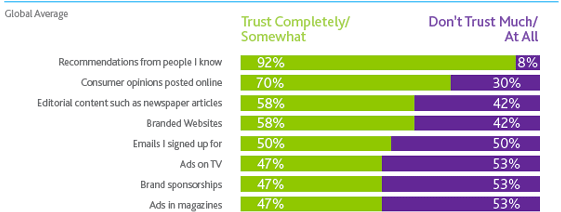
It’s a tacit way of saying “I recommend this.” In his popular book, Likeable Social Media, author Dave Kerpen says that a “friend’s recommendation is more powerful than any advertisement.” (It’s a New York Times best-seller, so who are we too argue!)

Social Shopping

While not an endorsement on my part, social commerce website ShopSocially provides a pristine example of how retailers can take advantage of this new “like” culture to build brand and increase sales.

The site promises to “turn 10-40% of your shoppers into brand ambassadors, increase engagement on Facebook and website by up to 30% to drive brand impressions and incremental clicks to [the retailer's] online store.”

The mechanism used by the site is to incentivize customers to share their purchases with friends on Facebook and Twitter, as well as through email. The site allows enables retailers to embed a sharing widget on their Facebook Page or ecommerce website.

Of course, that’s just one form of social shopping that utilizes the affinity model to drive sales. Another, ShopCade, is a Facebook social shopping app that connects people to shop and recommend products together.

Online Communities

One other example of how brands can use the affinity model is through the use of online communities. Proctor & Gamble have done this numerous times with sites like Super Savvy Me and Pampers Village. Most recently, the company launched such a community on Facebook for its Ivory soap brand. Called “The Soap Dish,” P&G tapped the talents of Emmy award-winner Melissa McCarthy to serve as brand spokesperson and host its new online social community.

The Soap Dish is Proctor & Gamble's newest online community.

Conclusion

Whether its for plastic containers, soap, diapers, beauty products, or what have you, brands are warming up to the idea that to be liked is a good thing. Many are leveraging the power contained within the psychology of social commerce to help consumers shop smarter using their social intelligence.

Share this:

Share

Tags: Proctor & Gamble

— Paul Chaney

Leave a Reply Cancel reply

Your email address will not be published. Required fields are marked *

*

*

HTML tags are not allowed.

  • Previous story How to Develop a Social Commerce Strategy that Works
  • Next story Social Commerce Rule of Thumb, Part 5: Consistency, Small Steps Lead to Big Ones
    • Recent Posts
    • Most Popular
    • EQIf social commerce is a Unicorn, there are a lot of Unicorns in ChinaMay 23, 2013
    • FTSpeed Summary: FT 2013 Special Report on the Connected BusinessMay 22, 2013
    • YahooTumblrThe Social Commerce Opportunity for Yahoo’s Tumblr – it’s called EtsyMay 20, 2013
    • screenshot_1894Warren Buffet “If you lose money for the firm I will be understanding. If you lose reputation I will be ruthless.” [Presentation]May 16, 2013
    • social_commerce_social_psychologyHow Social Commerce Works: The Social Psychology of Social ShoppingDecember 6, 2009
    • f-commercef-commerce statistics roundup: Facebook commerce by the numbersApril 4, 2011
    • FBStoreTop 50 Facebook Stores, Top 20 Facebook Store SolutionsMarch 11, 2011
    • screenshot_1559A Year in Social Commerce [infographic]December 30, 2010
  • About SCT

    Social Commerce Today is the leading online publication for news, comment and analysis in the field of social commerce, the art and science of selling with social technology.
  • About SYZYGY Group

    We're a network of specialist digital agencies. We create branded digital experiences designed to enrich the lives of people and the companies that serve them.
  • Check out what we do

    Ars Thanea


    HIRES


    Syzygy


    Unique_Digital

  • Download Our Latest Research Report

    Marsden_Digital_POS

  • Home
  • Psychology
  • Social Commerce Rule of Thumb, Part 4: Following Those Whom You Like, Know and Trust

© COPYRIGHT 2013 SOCIAL COMMERCE TODAY