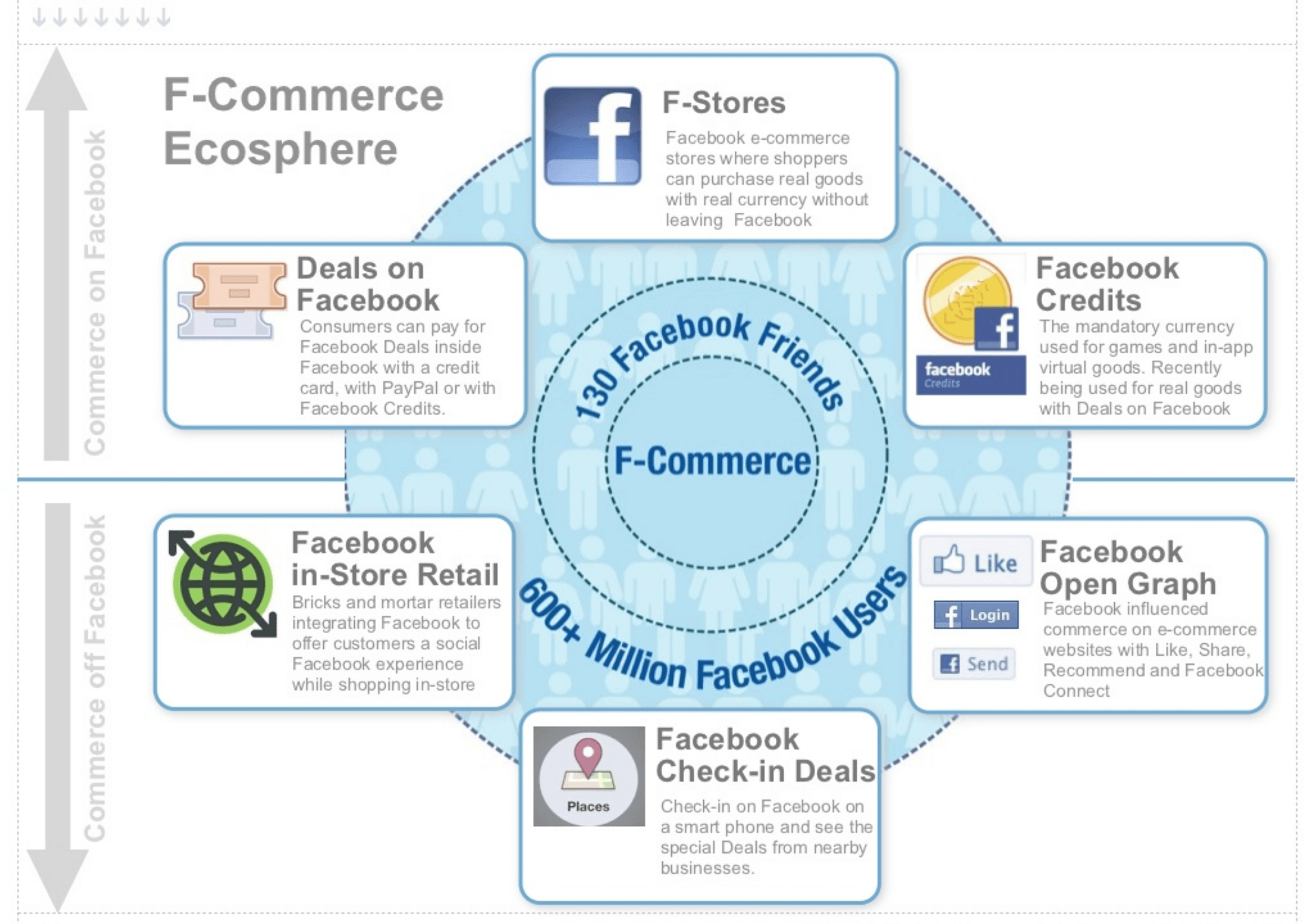
Janice Diner made a useful infographic summarising the current ‘ecosphere’ f-commerce and the six ways in which vendors are selling with Facebook.
It’s a useful snapshot of the fast-evolving world of f-commerce, and similar to that outlined in our f-commerce FAQ. It differentiates two basic forms of f-commerce – f-commerce where transactions take place on Facebook itself and f-commerce where transactions take place elsewhere (in-store, on external e-commerce sites). This is a useful distinction.
Defining f-commerce
In the context of Facebook, the term ‘f-commerce’ is new, and an accepted industry-wide definition has yet to emerge. Nominally f-commerce describes the range of activities in which Facebook is used to assist in the buying and selling of products and services. In this sense, f-commerce is a subset of social commerce – the use of social media, online media that supports social interaction and user contributions to assist in the buying and selling of products and services.
Like the term social commerce, f-commerce is used to describe a range of different activities, all related to buying and selling on Facebook. The useful distinction made in the infographic – on/off Facebook transactions, provides a way to organize everything that passes for f-commerce.
We’d propose extending off-Facebook f-commerce tools to include the range of developer tools that can be used to facilitate commerce – and we’d remove the “Facebook in-store Retail” entry, because unlike the other five elements in the ‘ecosphere’ is not a tool itself, but a bundle of tools that can be used in the context of in-store retail – including Facebook Check-in Deals and the Facebook Open Graph.
Thus we’d be tempted to replace “Facebook in-store Retail” with “Facebook Storefronts” (that allow page visitors to browse but not buy on Facebook) as well as other developer tools for Facebook Assisted Commerce, including social plugins. Perhaps this messes messed up the pleasing visual symmetry of original infographic, but it’s a little more complete.
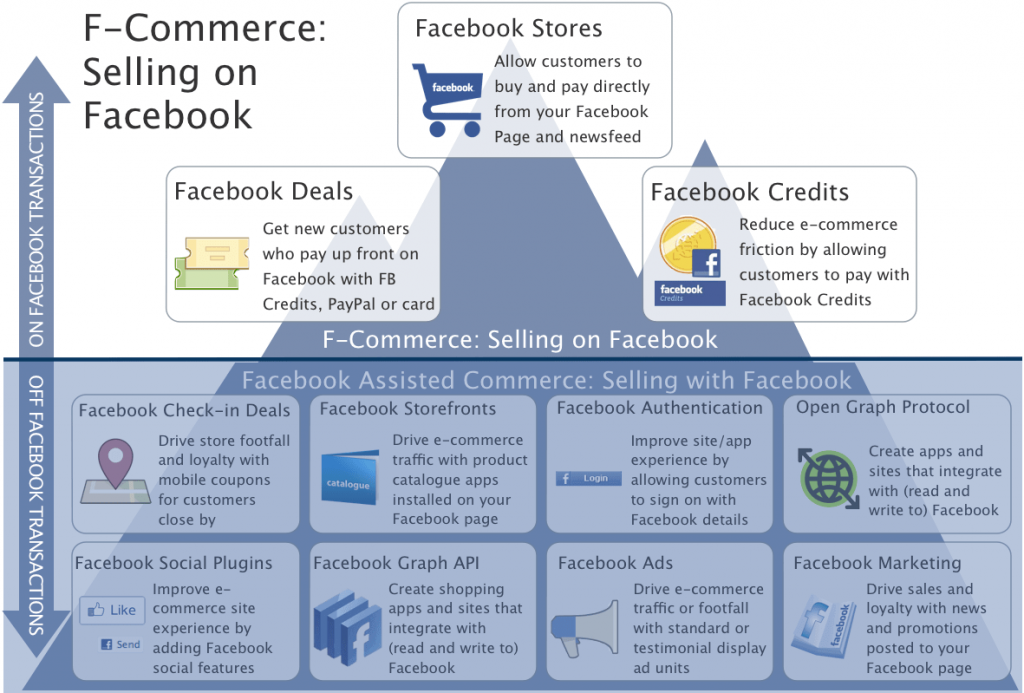
F-Commerce: Selling On Facebook
- Facebook Stores – third-party e-commerce applications installed on Facebook pages that enable users to shop and complete purchase transactions without leaving the network. For example, ASOS, JCPenney and Express that allow people to browse, share and buy from an e-commerce app on their Facebook page
- Facebook Deals – Facebook’s deal platform that enables vendors to get new customers who have paid upfront for pre-paid vouchers and that can be redeemed in-store or online. For example, the American Swim Association offers deals for pre-paid swimming lessons
- Facebook Credits – Facebook’s own currency, used for purchases made on Facebook for virtual goods, digital products, and Facebook deals. For example, Warner Bros. allows users to pay with Facebook Credits for its movie rental streaming service from Facebook pages (e.g. Harry Potter)
F-Commerce: Selling With Facebook
Beyond the use of Facebook as a sales platform, f-commerce can also denote ‘Facebook Assisted Commerce’, the use of Facebook to facilitate sales transactions that occur off-Facebook, through Facebook Storefronts, Facebook Check-in Deals, and software that uses the Facebook Open API to simplify, personalize and socialize the shopping experience. Thus, f-commerce is sometimes used to denote selling with Facebook as well as selling directly on Facebook:
- Facebook Storefronts – third-party Facebook applications for Facebook pages linked to external e-commerce sites, which allow visitors to browse, but not buy within the Facebook environment. For example, Apple has installed a Facebook application on it’s Facebook page that allows people to browse the Apple App Store, and then be redirected to product pages on its e-commerce site, where transactions are completed
- Facebook Developer Tools – the integration of Facebook features into an external in-store or e-commerce site experience via Facebook social plugins or custom software. For example, Macy’s and Diesel stores offer Facebook book connected fitting-room mirrors, allowing users to share try-outs with friends. In a similar vein, Renault, Hyundai, and Coca-cola offer real life ‘Like’ buttons at events. In the context of site-based e-commerce, vendors such as Levi’s and Amazon integrate with Facebook to offer personal stores based on Facebook user data, as well as the ability to communicate with Facebook friends
- Facebook Check-in Deals – a mobile check-in deals service for bricks and mortar vendors that drive store footfall. For example, H&M and Macy’s offer a 20% discount to people checking-in on their mobile Facebook app to their stores
- Facebook Marketing – the use of Facebook as a tool for sales promotion – ads, apps and newsfeed posts designed to drive traffic to Facebook stores, site-based e-commerce stores, or traditional stores. For example, Walmart installed a promotional app on its Facebook Page to drive in-store traffic by offering deals that would only go live once enough people had liked (i.e. shared) them. Similarly, Estée Lauder uses Facebook to drive footfall to store by advertising promotions such as a free set of Facebook profile photos, following a complimentary in-store make-up session.